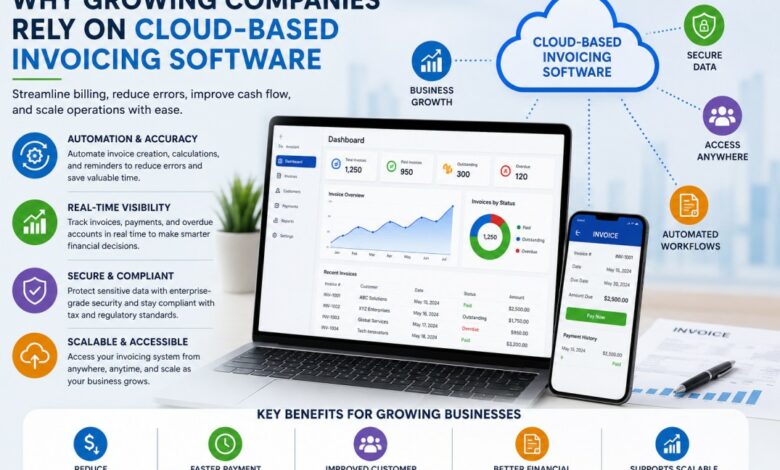
In today’s fast-paced business environment, financial accuracy and operational efficiency are critical for sustainable growth. As companies expand, managing invoices manually becomes increasingly challenging due to higher transaction volumes, multiple payment channels, and evolving compliance requirements. Cloud-based invoicing software has emerged as a practical solution that helps organizations streamline billing processes, improve financial visibility, and reduce administrative burdens. From startups to mid-sized enterprises, businesses are adopting digital invoicing systems to enhance productivity, strengthen cash flow management, and support scalable operations without increasing complexity.
Statistics Highlight the Shift Toward Digital Invoicing Systems
The growing adoption of cloud-based invoicing solutions reflects broader digital transformation trends across industries.
- Studies indicate that businesses can reduce invoice processing costs by more than 60% through automation.
- Automated invoicing systems significantly decrease human errors associated with manual data entry.
- Research shows that digital invoicing can shorten payment cycles and improve cash flow predictability.
- A large percentage of small and medium-sized businesses now use cloud-based accounting and billing platforms as part of their financial operations.
- Organizations implementing automated invoice workflows often report improved productivity among finance and administrative teams.
These trends demonstrate why modern businesses increasingly view cloud-based invoicing as an essential operational tool rather than an optional technology upgrade.
Cloud Platforms Simplify Billing Across Expanding Operations
As businesses grow, their invoicing requirements become more sophisticated. Companies may serve customers across different regions, manage multiple product lines, or work with diverse payment structures. Manual invoicing methods often struggle to keep pace with these demands.
Cloud-based invoicing software centralizes billing operations within a single digital environment. Employees can create, send, track, and manage invoices from virtually any location with internet access. This accessibility enables organizations to maintain consistency across departments while supporting remote and hybrid work models.
Centralized systems also provide better control over financial data. Instead of relying on spreadsheets, paper documents, or disconnected software tools, organizations gain access to a unified platform that supports accurate recordkeeping and streamlined workflows.
As transaction volumes increase, cloud solutions can scale accordingly without requiring major infrastructure investments. This flexibility makes them particularly valuable for businesses experiencing rapid growth.
Automation Reduces Errors and Improves Financial Accuracy
Invoice errors can lead to delayed payments, customer disputes, compliance concerns, and administrative inefficiencies. Manual processes often increase the likelihood of mistakes, especially when employees handle large volumes of invoices.
Cloud-based invoicing systems automate many repetitive tasks, including:
- Invoice creation
- Data entry
- Payment reminders
- Tax calculations
- Recurring billing schedules
- Financial reporting
Automation helps reduce the risk of duplicate invoices, incorrect calculations, and missing information. By minimizing human intervention in routine tasks, businesses can improve accuracy while freeing employees to focus on higher-value activities.
Many organizations also integrate white label invoice processing software into their financial workflows to standardize invoice handling across multiple clients or business units. These solutions contribute to greater consistency while maintaining operational efficiency.
Improved accuracy not only supports internal processes but also enhances customer trust by ensuring invoices are professional, transparent, and error-free.
Real-Time Visibility Enhances Cash Flow Management Efforts
Cash flow is one of the most important indicators of business health. Growing companies require clear visibility into outstanding payments, incoming revenue, and financial obligations to make informed decisions.
Cloud-based invoicing software provides real-time access to financial information. Business leaders can monitor invoice statuses, payment histories, and overdue accounts through centralized dashboards. This visibility enables faster decision-making and more proactive financial management.
Key benefits include:
- Faster identification of unpaid invoices.
- Improved forecasting of future cash inflows.
- Better tracking of customer payment behavior.
- Enhanced financial planning and budgeting.
- Reduced reliance on manual reporting processes.
Real-time insights help organizations address potential cash flow challenges before they become significant problems. By improving financial transparency, cloud invoicing solutions support stronger operational stability and growth planning.
Secure Infrastructure Supports Modern Compliance Standards
Data security remains a top priority for organizations handling financial information. Invoices often contain sensitive details, including customer information, transaction records, and payment data.
Cloud-based platforms typically incorporate advanced security measures such as:
- Data encryption
- Multi-factor authentication
- Role-based access controls
- Automatic backups
- Continuous monitoring
- Disaster recovery capabilities
These features help protect financial records from unauthorized access and data loss. Additionally, many cloud providers regularly update their systems to address emerging cybersecurity threats.
Compliance is another important consideration. Businesses operating across different jurisdictions must adhere to various tax regulations, record retention requirements, and reporting standards. Modern invoicing solutions often include compliance-related features that simplify adherence to regulatory obligations.
Organizations seeking highly customized financial systems frequently collaborate with a bespoke software development company to build solutions tailored to specific operational and compliance requirements. Such customization can further strengthen governance and reporting capabilities.
Integration Capabilities Strengthen Business Ecosystem Efficiency
One of the most significant advantages of cloud-based invoicing software is its ability to integrate with other business applications. Modern organizations rely on multiple digital tools to manage operations, sales, customer relationships, inventory, and accounting.
When invoicing software connects seamlessly with these systems, data flows automatically between platforms. This integration reduces manual data entry and improves operational consistency.
Common integrations include:
- Accounting software
- Customer relationship management systems
- Enterprise resource planning platforms
- Inventory management solutions
- Payment gateways
- Payroll systems
Integrated workflows create a more connected business environment where information is updated in real time. Employees spend less time transferring data between systems and more time focusing on strategic responsibilities.
Many growing organizations also implement white label invoice processing software within broader software ecosystems to ensure consistency across branded services and financial operations.
Remote Accessibility Supports Flexible Workforce Demands
Workplace flexibility has become a defining characteristic of modern business operations. Employees increasingly work from multiple locations, requiring access to essential systems regardless of physical office presence.
Cloud-based invoicing software enables teams to manage financial processes remotely while maintaining security and efficiency. Authorized users can generate invoices, review payment statuses, approve transactions, and access reports from virtually any connected device.
This accessibility provides several operational benefits:
- Faster response times to customer inquiries
- Improved collaboration among distributed teams
- Greater business continuity during disruptions
- Enhanced productivity outside traditional office settings
- Simplified management of geographically dispersed operations
Remote access ensures that critical invoicing functions remain available even during unexpected events that might otherwise disrupt business activities.
As organizations continue embracing hybrid and remote work models, cloud-based financial tools play an increasingly important role in maintaining operational resilience.
Advanced Features Deliver Greater Strategic Business Value
Modern invoicing platforms offer capabilities that extend beyond basic billing functions. Many solutions provide advanced analytical and operational features that support long-term business growth.
Examples include:
- Custom reporting dashboards
- Revenue trend analysis
- Automated payment reconciliation
- Customer payment behavior insights
- Multi-currency invoicing
- Subscription billing management
- Tax automation tools
These capabilities help organizations gain deeper insights into financial performance and operational efficiency.
Some businesses also leverage solutions that complement white label tax preparation software to create more comprehensive financial management ecosystems. By combining invoicing, tax management, and reporting functions, organizations can improve accuracy while simplifying administrative processes.
Additionally, advanced analytics enable leadership teams to identify trends, optimize processes, and make more informed strategic decisions.
Scalability Enables Sustainable Long-Term Business Growth
One of the primary reasons growing companies choose cloud-based invoicing software is scalability. Traditional invoicing systems often require significant upgrades as transaction volumes increase. In contrast, cloud platforms are designed to accommodate expansion with minimal disruption.
Scalable solutions allow businesses to:
- Add new users quickly
- Manage higher invoice volumes
- Support additional business locations
- Expand into new markets
- Handle more complex billing structures
- Adapt to changing operational requirements
This flexibility ensures that invoicing infrastructure can evolve alongside business growth rather than becoming a limiting factor.
Furthermore, organizations can often customize workflows, permissions, and reporting structures to align with changing business needs. Many companies adopt white label invoice processing software as part of their growth strategy because it supports operational consistency while accommodating expansion across multiple customer segments and service offerings.
Scalable invoicing systems help businesses maintain efficiency, accuracy, and control throughout various stages of development.
Conclusion
Cloud-based invoicing software has become an essential component of modern business operations. By automating routine tasks, improving accuracy, enhancing visibility, strengthening security, and supporting scalability, these solutions help organizations manage increasingly complex financial processes with greater efficiency. As digital transformation continues to reshape business environments, companies that embrace intelligent invoicing technologies will be better positioned to adapt to changing market demands, improve operational performance, and maintain sustainable growth over the long term.


