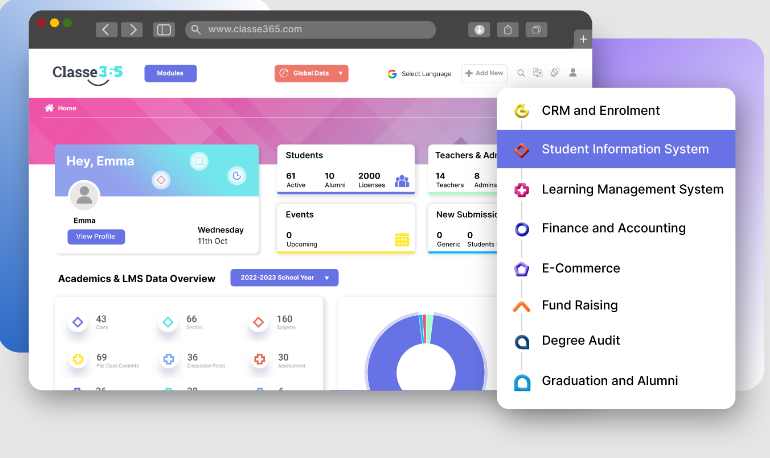
As education continues its rapid digital evolution, institutions in 2025 face a familiar but increasingly critical question: Do we need an SIS, an LMS, or both? With rising student expectations, stricter compliance requirements, hybrid learning models, and AI-driven analytics becoming mainstream, choosing the right core platform is no longer a technical decision—it’s a strategic one.
Schools, colleges, universities, and training organizations now rely on integrated technology ecosystems to manage operations and deliver learning experiences. Understanding the difference between SIS Systems and Learning Management Systems (LMS) is essential for leaders who want to scale efficiently, reduce administrative friction, and improve student outcomes without over-investing in overlapping tools.
Key Takeaways
-
SIS and LMS platforms serve different but complementary purposes in education technology
-
SIS focuses on student data, administration, and institutional operations, while LMS centers on teaching and learning delivery
-
Choosing the wrong system (or only one when both are needed) can create data silos and operational inefficiencies
-
Modern institutions increasingly benefit from integrated SIS–LMS ecosystems rather than standalone tools
Understanding the Core Purpose of SIS and LMS Platforms
At a high level, both systems support education—but they operate at different layers of an institution.
A Student Information System (SIS) is the administrative backbone of an educational institution. It manages student records, admissions, enrollment, attendance, grades, compliance, billing, and reporting. In contrast, a Learning Management System (LMS) is designed to deliver, manage, and track learning content, assessments, and student engagement within courses.
Think of it this way:
-
The SIS runs the institution
-
The LMS runs the classroom
While this distinction sounds simple, real-world usage often overlaps, which is where confusion begins.
What SIS Systems Are Designed to Handle
SIS platforms are built for operational efficiency and data integrity across the student lifecycle. From the moment a learner applies until long after graduation, the SIS remains the system of record.
Key capabilities typically include:
-
Admissions and enrollment management
-
Student profiles and academic history
-
Attendance and grading records
-
Fee management and financial data
-
Compliance, accreditation, and reporting
-
Parent, student, and staff portals
In 2025, modern SIS Systems have expanded beyond basic record-keeping. AI-powered analytics, workflow automation, CRM-style communication tools, and real-time dashboards are becoming standard expectations rather than premium features.
What Learning Management Systems Do Best
An LMS is built to support teaching, learning, and assessment delivery—especially in online and blended environments.
Common LMS features include:
-
Course creation and content management
-
Assignment submission and grading
-
Quizzes, exams, and assessments
-
Discussion forums and collaboration tools
-
Learning progress tracking
-
Integration with video conferencing and content libraries
LMS platforms shine in instructional design and learner engagement, but they are not intended to manage institutional operations, compliance, or financial processes.
Where the Confusion Comes From
The confusion between SIS and LMS often arises because:
-
Some LMS platforms add light administrative features
-
Some SIS platforms include basic learning tools
-
Vendors use overlapping terminology in marketing
-
Institutions try to solve all problems with one system
This overlap can lead organizations to adopt an LMS expecting it to replace an SIS—or vice versa—only to discover gaps that affect reporting, scalability, or compliance.
Comparing SIS Systems and LMS Across Key Dimensions
Data Ownership and Accuracy
SIS platforms act as the single source of truth for student data. They ensure accuracy, consistency, and compliance across departments.
LMS data, on the other hand, is course-specific and often temporary. Grades and activity logs may not meet institutional or regulatory reporting standards unless synced back to the SIS.
Administrative Efficiency
SIS Systems are purpose-built to reduce administrative workload through automation and centralized data management. Tasks like enrollment updates, transcript generation, and fee reconciliation depend on SIS functionality.
An LMS cannot replace these processes without heavy customization or manual workarounds.
Teaching and Learning Experience
LMS platforms provide richer tools for content delivery, collaboration, and assessment design. While some SIS platforms offer basic learning features, they rarely match the instructional depth of a dedicated LMS.
Scalability and Integration
As institutions grow, the need for integrations becomes unavoidable. SIS platforms typically integrate with LMS, CRM, finance, and analytics tools to support scale.
In 2025, institutions increasingly favor SIS-led ecosystems where the LMS plugs into the core data layer rather than operating in isolation.
Benefits of Using Both Systems Together
Rather than choosing between the two, many institutions achieve the best results by integrating SIS and LMS platforms.
Key benefits include:
-
Seamless data flow between enrollment, grades, and learning outcomes
-
Reduced duplicate data entry and fewer errors
-
Better visibility into student performance and retention risks
-
Improved experience for students, faculty, and administrators
When SIS and LMS systems are tightly connected, institutions gain a holistic view of both academic progress and operational health.
Challenges Institutions Commonly Face
Despite the benefits, institutions often encounter challenges such as:
-
Poor integration between SIS and LMS platforms
-
Fragmented user experiences across systems
-
Manual syncing of grades and attendance
-
Resistance to adoption from faculty or staff
These issues are rarely caused by the concept of using both systems—but rather by selecting tools that were not designed to work together or lack modern APIs and automation capabilities.
Best Practices for Selecting the Right Solution
When evaluating SIS and LMS options, institutions should focus on outcomes rather than features alone.
Actionable best practices include:
-
Start with institutional goals, not software checklists
-
Prioritize SIS platforms that integrate natively with leading LMS tools
-
Ensure reporting and compliance needs are met first
-
Evaluate long-term scalability, not just current size
-
Involve both academic and administrative stakeholders in decision-making
Institutions that treat SIS selection as a strategic foundation rather than a back-office tool tend to see stronger ROI and smoother digital transformation.
Frequently Asked Questions
Can an LMS replace an SIS?
No. An LMS cannot fully replace an SIS because it lacks robust student records, compliance reporting, financial management, and administrative workflows required by institutions.
Do small schools need both SIS and LMS?
Small schools may start with one system, but as they grow or adopt blended learning, having both becomes increasingly important for efficiency and data accuracy.
Are SIS Systems still relevant with modern LMS platforms?
Absolutely. SIS Systems remain critical as the authoritative source of student data and institutional operations, even as LMS platforms evolve.
How do SIS and LMS platforms integrate?
Most modern platforms integrate via APIs or native connectors, allowing real-time syncing of enrollment data, grades, and attendance.
What should institutions prioritize first: SIS or LMS?
Institutions should prioritize SIS first, as it establishes the data foundation upon which LMS and other tools can reliably operate.
Ready to Build a Smarter Education Technology Stack?
Choosing between SIS and LMS is no longer an either–or decision—it’s about building a connected ecosystem that supports growth, compliance, and student success. Institutions that invest in flexible, future-ready platforms are better positioned to adapt to changing learning models and rising expectations.
Solutions like Classe365 exemplify this modern approach by combining robust SIS capabilities with seamless LMS integrations, helping institutions simplify operations while delivering engaging learning experiences. By choosing platforms designed for today’s educational realities, organizations can move forward with confidence, clarity, and control.


