Off-the-Shelf vs Custom eCommerce Development: Key Differences

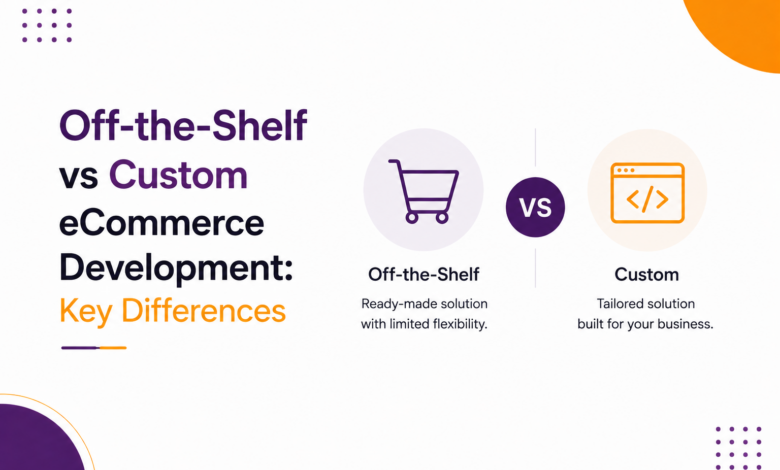
Choosing an eCommerce platform is one of the first major technology decisions for an online business. The choice usually comes down to two options: use an off-the-shelf platform or build a custom eCommerce solution.
Both approaches can work well. The right option depends on your business model, growth plans, budget, operational needs, and the type of customer experience you want to deliver.
Off-the-shelf platforms offer a faster path to launch. Custom development gives businesses greater control over features, workflows, integrations, and scalability.
Understanding the difference between Off-the-Shelf vs Custom eCommerce Development can help businesses choose an approach that fits their current requirements without creating unnecessary limitations as they grow.
What Is Off-the-Shelf eCommerce Development?
Off-the-shelf eCommerce development involves using an existing platform to build and manage an online store.
These platforms typically provide ready-made features for product management, payments, checkout, order processing, and other common eCommerce functions. Businesses can choose a theme, configure the available settings, install extensions, and launch without building everything from scratch.
This approach works well for businesses with relatively standard requirements.
Key advantages
The biggest advantage is speed. Since the core platform already exists, businesses can launch faster than they would with a fully custom solution.
Other benefits include:
- Lower initial development costs
- Pre-built eCommerce features
- Faster implementation
- Existing themes and extensions
- Ongoing platform updates
- Easier setup for standard business models
For a new business testing an idea or a company with straightforward selling requirements, an off-the-shelf solution can be a practical starting point.
However, convenience can also create limitations when the business needs functionality that the platform was not designed to support.
What Is Custom eCommerce Development?
Custom eCommerce development involves building an online shopping experience around the specific requirements of the business.
Instead of adapting business processes to fit the limitations of a pre-built platform, the software can be designed around existing workflows, customer requirements, integrations, and future plans.
A custom solution may include unique product configurations, specialized checkout processes, complex pricing rules, B2B capabilities, marketplace functionality, or integrations with internal business systems.
The main advantage is flexibility.
However, custom development requires a larger upfront investment and more planning.
1. Development Time and Speed to Market
Off-the-shelf platforms generally have a faster implementation timeline because many of the essential features are already available.
A business can focus on configuring the platform, adding products, setting up payments, and customizing the design.
Custom development takes longer because the solution needs to be planned, designed, developed, tested, and deployed around specific requirements.
That does not necessarily mean custom development is the wrong choice.
If a business spends months trying to force complex workflows into an existing platform, a custom solution may eventually become the more efficient option.
The decision should depend on how quickly the business needs to launch and how much functionality is required for the first version.
2. Customization and Flexibility
This is one of the biggest differences between the two approaches.
Off-the-shelf platforms allow customization, but only within the capabilities of the platform and its ecosystem. Businesses can use themes, applications, plugins, and extensions, but complex requirements may require workarounds.
Custom eCommerce development provides greater control over how the platform works.
Businesses can build:
- Custom product workflows
- Personalized customer experiences
- Specialized pricing models
- Unique checkout processes
- Advanced search and filtering
- Custom user roles
- Business-specific dashboards
This flexibility is particularly useful when the online store is closely connected to unique business processes.
3. Scalability and Business Growth
Every eCommerce business wants to grow, but growth can create new technical and operational requirements.
More customers may mean higher traffic. More products may require better catalog management. Expansion into new markets may introduce additional currencies, taxes, languages, and fulfillment processes.
Off-the-shelf platforms can support significant growth, but businesses remain dependent on the platform’s available capabilities and infrastructure.
A custom solution can be designed around specific scalability requirements. The architecture, integrations, database structure, and performance strategy can evolve based on the needs of the business.
However, scalability also depends on good technical planning. A custom platform is not automatically scalable simply because it is custom-built.
4. Integrations and Business Operations
An eCommerce store rarely operates alone.
It may need to connect with an ERP, CRM, inventory system, payment gateway, shipping provider, marketing platform, or other internal applications.
Off-the-shelf platforms often provide ready-made integrations for popular tools. This can save time when the required integration already exists.
The challenge arises when a business uses a specialized or proprietary system.
Custom eCommerce development can provide more flexibility for building APIs and integrations around existing business operations.
This can reduce manual data entry and help create more connected workflows across the organization.
5. Ownership and Control
With an off-the-shelf platform, businesses operate within the rules and technical structure defined by the platform provider.
Changes to pricing, policies, supported features, APIs, or extensions can affect how the business operates.
A custom solution gives the business greater control over the technology and functionality being developed.
This does not mean businesses avoid all third-party dependencies. Most modern eCommerce platforms still rely on external services for payments, hosting, analytics, or other capabilities.
The difference is that businesses have more control over how those services are connected and how the overall system evolves.
6. Upfront and Long-Term Costs
Off-the-shelf platforms generally have lower upfront costs. Businesses pay for subscriptions, themes, extensions, and implementation work instead of funding development from the ground up.
Custom development usually requires a higher initial investment because the platform is built specifically for the business.
However, the initial price should not be the only factor.
Businesses should also consider long-term costs related to:
- Platform subscriptions
- Third-party applications
- Customizations
- Maintenance
- Infrastructure
- Integrations
- Performance improvements
A low-cost platform can become expensive if a business depends heavily on multiple paid extensions and ongoing custom work.
Likewise, a custom solution can become costly if it is poorly planned or requires constant redevelopment.
7. Security and Maintenance
With an off-the-shelf platform, the provider often manages a significant part of the platform’s security, infrastructure, and updates.
This can reduce the technical workload for internal teams.
With a custom eCommerce solution, businesses have more responsibility for maintaining the application, monitoring performance, applying security updates, and managing infrastructure.
The benefit is greater control. The responsibility is the need for an ongoing maintenance strategy.
Before choosing either option, businesses should understand who will manage the platform after launch.
So, Which Option Is Right for Your Business?
There is no single answer.
An off-the-shelf platform may be the right choice if your business needs standard eCommerce functionality, wants to launch quickly, and has a limited budget.
Custom development may make more sense when your business has unique workflows, complex integrations, specialized customer experiences, or requirements that cannot be efficiently supported by an existing platform.
The best decision starts with understanding your actual requirements rather than choosing a technology first.
A clear assessment of the difference between Off-the-Shelf vs Custom eCommerce Development can help businesses evaluate flexibility, cost, scalability, integrations, and long-term ownership before making a technology investment.
Working with an experienced eCommerce Consulting Company can also help you assess your current requirements and determine whether an existing platform, a customized solution, or a fully custom approach makes the most sense.
For businesses that need help designing or building an online store, professional eCommerce web development services can support everything from platform selection and UX to integrations and custom functionality.
And if your growth strategy includes a dedicated mobile shopping experience, Ecommerce App Development can help extend your digital commerce ecosystem beyond the web.
The key is not to choose the most popular option. It is to choose the eCommerce approach that supports how your business operates today and gives you enough flexibility for where it needs to go next.