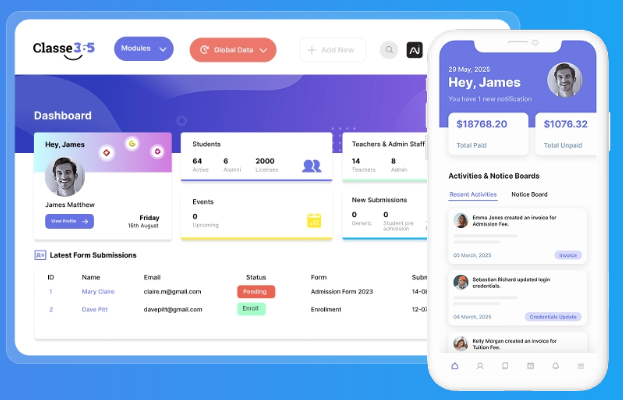
Student recruitment is undergoing one of the biggest shifts the education sector has seen in years. As institutions navigate rising competition, evolving student expectations, and an increasingly digital-first landscape, traditional recruitment workflows are no longer enough. In 2025, many schools, colleges, and universities began adopting data-driven tools to keep pace—but 2026 will mark a turning point where automation, personalization, and intelligent engagement become the standard.
At the center of this transformation is Education CRM Software.
Built to streamline recruitment journeys from first inquiry to final enrollment, these platforms allow institutions to operate with precision, speed, and meaningful insights. For education providers aiming to grow sustainably in 2026 and beyond, CRM-powered recruitment is no longer optional—it’s a strategic necessity.
Key Takeaways
-
How Education CRM Software is reshaping student recruitment through automation, personalization, and analytics
-
The challenges institutions face with traditional recruitment models
-
The top features to look for in a next-generation education CRM
-
Actionable strategies for successfully selecting, implementing, and optimizing CRM for recruitment
-
Important FAQs answered for institutions evaluating CRM adoption
Why Student Recruitment Needs a Smarter Approach in 2026
Students today expect immediate responses, seamless communication, and personalized experiences from education providers—similar to what they receive from leading consumer brands. Institutions that rely on spreadsheets, manual follow-ups, or disconnected systems struggle to keep up.
In 2026, student recruitment teams will deal with:
-
Higher competition across global and online programs
-
Increased marketing costs and reduced attention spans
-
A need to analyze data faster and act on trends in real time
-
Growing demand for unified, mobile-friendly communication
This is where Education CRM Software becomes transformative. It centralizes recruitment data, automates communication, and equips teams with insights that help them convert more inquiries into enrollments—efficiently and predictably.
Understanding What Modern Education CRM Software Can Do
The power of Education CRM Software lies not only in data storage but in how it enables personalized, timely, and meaningful engagement with prospects.
1. Automated Lead Capture and Nurturing
Recruitment teams often lose leads simply because they cannot respond fast enough.
A CRM eliminates this gap by:
-
Capturing leads from websites, landing pages, events, and ads
-
Automatically sending personalized emails or WhatsApp messages
-
Assigning leads to counselors based on territory or program
-
Nudging prospects with reminders, follow-ups, and timely content
Instead of spending hours manually managing inquiries, counselors can focus on building relationships.
2. Centralized Student Profiles
Every student interaction—emails, calls, forms, applications, events—can be tracked in a single profile.
This gives counselors an instant understanding of:
-
A prospect’s interests
-
Enrollment readiness
-
Their engagement with campaigns
-
Barriers or concerns they’ve shared
In 2026, this unified visibility will be essential for delivering richer and more tailored recruitment experiences.
3. Personalization at Scale
Students want communication that feels relevant, intentional, and timely.
With intelligent segmentation, a CRM can send:
-
Program-specific messages
-
Location-based campaigns
-
Behavior-triggered workflows
-
Personalized reminders for deadlines or documents
This level of personalization, once impossible manually, is now both scalable and automated.
4. Recruitment Analytics and Forecasting
Institutions often struggle to calculate the ROI of recruitment campaigns.
A CRM solves this through:
-
Lead source tracking
-
Funnel conversion analytics
-
Counselor productivity dashboards
-
Predictive scoring for high-intent applicants
Recruitment teams gain clarity on what’s working, what’s not, and where to invest for the strongest outcomes.
Common Challenges Institutions Face Without CRM
Even high-performing institutions face bottlenecks when they rely on traditional recruitment methods. These include:
-
Slow response times leading to lost inquiries
-
Disconnected systems that prevent data visibility
-
Inconsistent team follow-up and communication gaps
-
Difficulty forecasting enrollments accurately
-
Minimal personalization in outreach
-
Manual data entry leading to errors
In 2026, these challenges become more pronounced as student competition intensifies.
Adopting Education CRM Software is the only scalable way to solve them.
Key Features to Look for in a Next-Generation Education CRM
Choosing the right CRM can influence an institution’s growth for years. The most impactful ones include:
1. Multi-Channel Communication Tools
Email, SMS, WhatsApp, chatbots, and voice calls integrated into one platform.
2. Marketing Automation
Trigger-based journeys, drip campaigns, auto-follow-ups, and nurturing sequences.
3. Application Management
Easy-to-use forms, document uploads, application tracking, and decision workflows.
4. Lead Scoring & Analytics
Identify high-intent candidates using behavior-led scoring models.
5. Integrations
Seamless sync with SIS, LMS, ERP, website forms, and payment gateways.
6. Mobile Access
Recruiters on the move can respond instantly using mobile apps.
7. AI Recommendations (Key for 2026)
AI-powered insights that suggest probability of conversion, ideal communication timing, and next steps.
These features collectively improve efficiency, reduce recruitment costs, and accelerate conversions.
Best Practices to Implement and Optimize CRM for Student Recruitment
To fully leverage CRM capabilities, institutions should follow a structured approach.
1. Map Your Recruitment Funnel Before Implementation
Identify stages such as inquiry, prospect, applicant, verified applicant, and enrolled.
This helps configure your CRM workflows accurately.
2. Use Automation, But Keep Human Touch
Automate repetitive reminders—but ensure counselors still build personal connections when it matters.
3. Train Teams Continuously
Recruitment success depends on counselor adoption.
Offer regular training on:
-
Using dashboards
-
Updating records
-
Leveraging communication tools
4. Utilize Data for Smarter Decision-Making
Use CRM insights to:
-
Allocate marketing budget
-
Identify top-performing channels
-
Adjust messaging based on engagement
5. Integrate With Your SIS or LMS
A connected ecosystem reduces manual work and enhances student experience across the entire lifecycle.
Frequently Asked Questions
1. What is Education CRM Software and how does it help recruitment?
Education CRM Software is a specialized system designed to manage the student recruitment funnel. It helps institutions capture leads, automate communication, track interactions, and analyze performance to increase conversions.
2. Is Education CRM different from a regular CRM?
Yes. While general CRMs support sales workflows, education CRMs are built specifically for admissions, student engagement, academic workflows, and communication needs unique to educational institutions.
3. Can small institutions benefit from a CRM?
Absolutely. Smaller institutions often see the fastest ROI because automation reduces manual workload and improves recruitment efficiency.
4. How long does it take to implement an education CRM?
Most cloud-based systems can be implemented within a few weeks, depending on data migration, integrations, and team training requirements.
5. What KPIs should institutions track using a CRM?
Key KPIs include inquiry-to-application rate, application-to-enrollment rate, counselor response time, lead source ROI, and communication engagement metrics.
6. Is automation too impersonal for student communication?
Not when used correctly. Automation handles repetitive tasks, while counselors focus on meaningful interactions. This balance actually improves personalization and response time.
Start Transforming Your Recruitment Strategy With the Right CRM
As 2026 approaches, institutions that adopt an intelligent, integrated recruitment ecosystem will gain a clear competitive advantage. Education CRM Software is no longer just a tool—it’s a growth strategy that modern institutions must embrace to attract the right students and deliver exceptional experiences at scale.
For institutions seeking a reliable, innovative, and future-ready solution, platforms like Classe365 provide all-in-one capabilities that seamlessly connect recruitment, admissions, academics, and student management. With the right CRM in place, your institution can build stronger relationships, accelerate enrollment growth, and create a more personalized student journey from the very first interaction.


